

 LinkedIn
You can buy AI brand monitoring for $29 a month. If you want to do something about what it finds, plan for roughly $2,000 to $7,000 a month during the first 90 days, depending on how much work you can do yourself.
That is the gap vendors tend to skip. Otterly Lite costs $29 a month for 15 prompts, and I can see why an owner would sign up thinking the job was handled. But a report saying your brand is missing from ChatGPT is like a PPC report saying your Quality Score is 4/10. It names the problem. It does not fix it. What the deck calls visibility tracking, I call paying for someone to point at the leak without patching it.
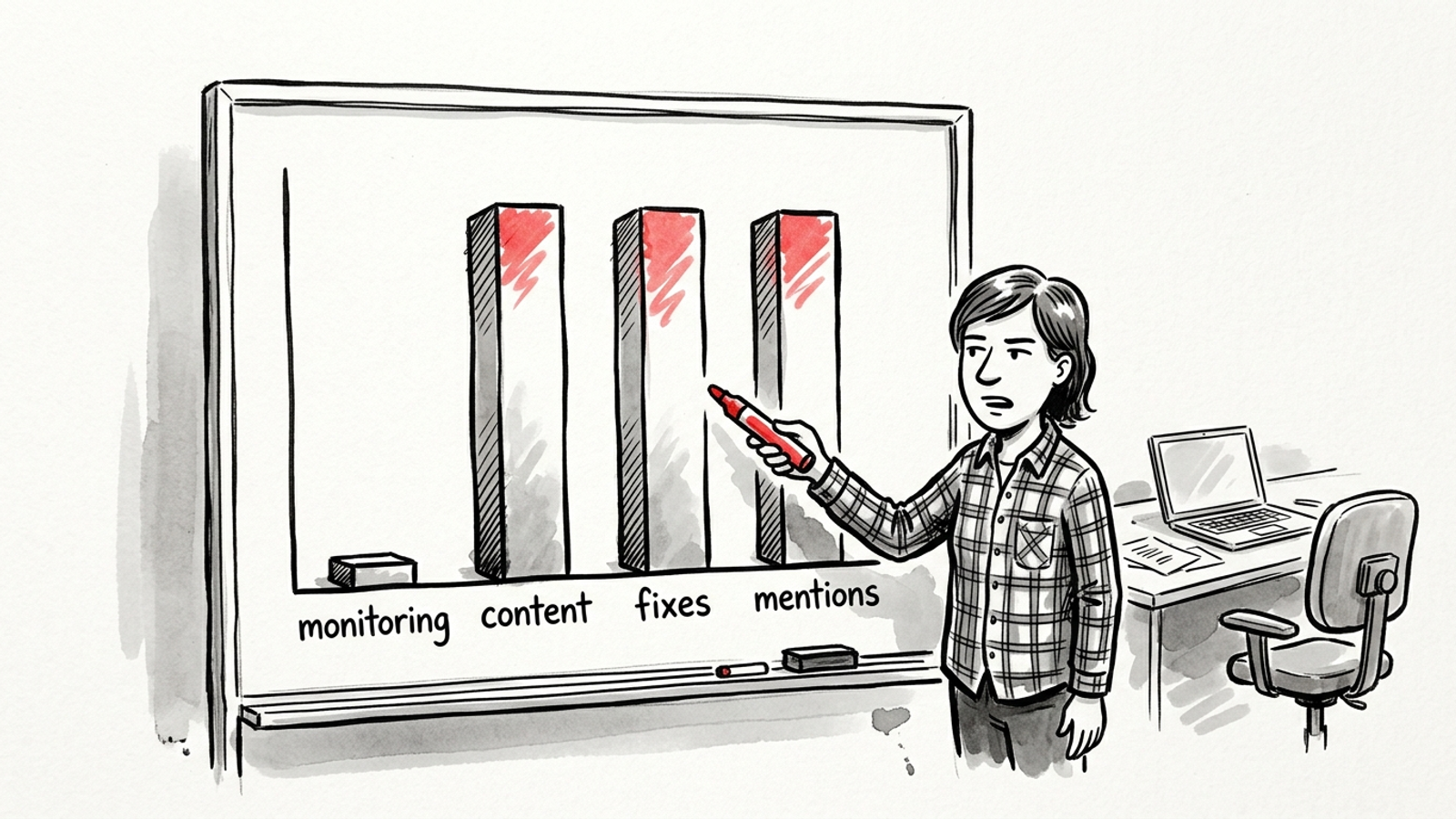
I used to tell PPC clients the report was the first step. That was true, but it let me understate the bill for the steps after it. Monitoring is the cheap line item. Pages, technical fixes, off-site mentions, and the time to make sense of the data are the rest of the invoice.
The seven-line bill vendors rarely put on one page
I price this the way I used to price a PPC account: software, setup, labor to read the data, labor to act, and work you have to buy from someone else. The figures below are published prices where linked and planning assumptions where labeled. Some are one-off; others keep billing while you wait to see a result.
| Line item | Monitor-only | Monitor and execute | Basis and cost driver |
|---|---|---|---|
| 1. Tracking software | $29–$495/month | Same, plus any add-ons | Otterly and Peec plan prices; prompt counts, engines, and add-ons |
| 2. Prompt set | $0 with a template | $300–$2,000 one-off; refreshes take more work | Freelance content-gap analysis pricing; buyer research and local variants |
| 3. Reading results | About 1 hour/month to skim | 3–6 hours/month | Freelance SEO rates of $75–$200/hour; investigation and briefing time |
| 4. Citable content | $0 | $600–$4,000/month as a planning range | Content rates and article prices; page count, depth, and specialist time |
| 5. Technical work | $0 | $500–$5,000 for an audit, with schema and development potentially extra | Crawl access, rendering, speed, and what the site needs fixed |
| 6. Off-site work | $0 | $1,000–$8,000+ for a link campaign, or a different budget for lean outreach | Placements, outreach, reviews, and partner participation |
| 7. Waiting for results | No execution spend | Allow 2–4 months of program spend before judging the work | Publishing and iteration pace; this is a planning allowance, not a promised result |
Do not add every maximum in that table and call it a quote. A campaign of 30 links and a lean outreach effort are different choices, and an audit is not a monthly subscription. The point is to see the charges the software price leaves out. If you want the cheapest monitoring path, you can build a weekly monitor in Sheets with three APIs. You still have to decide what to do when the sheet turns red.
Line 1: The advertised price buys prompts, not progress
Otterly lists Lite at $29 for 15 prompts, Standard at $189 for 100, and Premium at $489 for 400. Peec lists Starter at $95 for 50 prompts and three engines, Pro at $245 for 150, and Advanced at $495 for 350. Profound starts at $99 for ChatGPT-only monitoring, while its Growth plan starts at $399.
Those prices are useful only after you know which prompts and engines you need. Otterly’s base coverage includes ChatGPT, Perplexity, AI Overviews, and Copilot; Gemini, Google AI Mode, and Claude are paid add-ons, priced by tier. A $29 headline is not a quote for every engine an owner might want to watch. Nor is a larger prompt allowance valuable if the prompts are the wrong ones.
Price the coverage you will use, including add-ons, before comparing plans. The tool bill is real. It is just not the outcome bill.
Line 2: A useful prompt set is a one-off job that needs refreshing
A template list of 15 prompts takes an afternoon. A list that reflects buying decisions takes more work: pull Search Console queries, questions from sales calls, competitor comparisons, and local variants. Then rewrite them in the language a buyer would use with ChatGPT or Gemini. That is close to a content-gap analysis, which freelancers price at $300 to $2,000 as a one-off.
For a worked budget, say you spend $20,000 a month on ads and allocate $800 once to build the set, then $200 a quarter to refresh it. Those are assumptions for the example, not vendor prices. Skip the work and you can end up celebrating visibility on 15 tidy, vendor-written prompts while the questions your buyers ask never mention you. I have seen owners make that mistake.
If prompt design costs $0, check whether you bought coverage or merely a template.
Line 3: The dashboard has to become a decision
This is where the PPC parallel gets uncomfortable. A rank tracker emails you a red chart. Someone still has to decide whether the movement matters, investigate it, and tell the writer or developer what to change. For a small site, budget 3 to 6 hours a month for that loop rather than assuming a glance at the dashboard will do it.
Price those hours at your own rate. At a freelance SEO average of $111 an hour, within a $75-to-$200 range, four hours comes to $444 a month in review labor for a tool that might cost $29. In-house, the cash outlay may be lower. The work still takes your time, often at the least convenient point in the week.
One practitioner puts the division plainly: platforms report the gap; they do not close it. A consultancy can hand you a plan, too. Without capacity to publish or fix anything, both leave you with a more detailed description of the same problem.
Log your review hours for one month. If you cannot name the action each review produced, you are buying reports, not running a program.
Line 4: The pages are where the recurring bill starts
The dashboard will show questions on which other sources appear and you do not. Then you need pages worth using as answers. For a small business, an illustrative first-quarter workload is two to four pages a month: perhaps a service page rewritten around a direct answer, a comparison page, and a pricing or process page. The mix depends on the gaps. The writing still has to happen.
The published price bands are broad. Freelance specialists charge $0.30 to $1 or more per word, or $500 to $2,000 or more per article; Verblio’s human writing is listed at $0.16 per word, about $240 for 1,500 words. Another content-only range is $150 to $800 per article, before publishing and links. For the worked budget below, three pages at $600 each put content at $1,800 a month.
I would rather publish two clear pages than four thin ones written to fill a prompt-count spreadsheet. A buyer looking for a price, a process, or a comparison needs the answer on the page. A dashboard cannot supply it for you.
If you cannot publish two useful answer pages a month, do not pay extra to track 100 prompts.

Line 5: Technical fixes are one-off costs, until someone breaks them
The writing bill is visible. The technical one often appears only after you have paid for content. Check whether the pages can be fetched and rendered, whether robots rules block relevant crawlers, and whether speed or site changes get in the way. Then pay someone to ship the fixes. An audit that produces a list is not the same as a completed job.
A technical audit and fix list runs $500 to $5,000; schema implementation is listed separately at $300 to $3,000. Development adds another variable. For the example below, I use $1,200 one-off for a WordPress site: $700 for audit and schema work and $500 for development, with mid-range freelance development rates of $60 to $120 an hour as the reference. Your site may need less. If nobody has access to fix it, it may need considerably more.
I learned to watch this on PPC landing pages. Someone swaps a template, the page slows down, and the campaign team keeps adjusting ads while the page is the problem. Do not make the AI-search version of that mistake.
Check fetch and rendering before funding a quarter of new pages. Put the audit and the fixes in the one-off column, not inside an imaginary $29 subscription.
Line 6: Off-site work is not a dashboard feature
Even a good page does not give you control over what other sites say about you. The off-site work may involve reviews, relevant Reddit conversations, partner pages, listicles, or press. A monitor can show where you are absent. It cannot create a legitimate third-party mention by drawing another chart.
Costs depend on the approach. A campaign for 10 to 30 links is priced at $1,000 to $8,000 or more, while a single guest post is listed at $50 to $1,000 or more. Those are different purchases, not a menu I would blindly order from. Done-for-you programs cited in the draft run from $6,000 to $6,200 a month at Derivatex and $10,000 at Omniscient. They show how far the bill can move when someone else handles more of the work.
For a lean in-house example, I set aside $800 a month for outreach and placements once content starts shipping. That is a budget assumption, not a quote for the link campaign above. If you can earn mentions through existing partners and customers, your cash bill may differ. Someone still has to make the ask and follow through.
Budget for real participation and mentions, not a higher prompt limit.
Line 7: Lag turns every monthly cost into a patience test
Software, review time, content, and outreach can all bill before you can point to a citation or attributable return. The working allowance here is two to four months before judging the program. That is not a guarantee that a model will mention you at the end of month four. It is a reminder to decide in advance how long you can fund the work and how you will judge whether it is improving.
If you spend $2,500 a month for three months without an attributable win, that is $7,500 spent during the learning period. Agencies feel that as churn. Owners feel it as doubt. I have watched PPC clients pause work at exactly the moment everyone finally understood what needed fixing. Sometimes the work was wrong; sometimes the budget had simply never accounted for iteration.
A team that can publish and respond quickly has more chances to learn than one that ships a page and disappears for a month. Put the waiting period in your budget before the first invoice arrives.
A worked first-quarter bill, with the add-ons left visible
Take a lean shop monitoring 60 buyer prompts across the engines included in an Otterly Standard plan. A monitor-only month is $189 for software plus one hour at $111 to skim the results: about $300 a month. If Gemini is essential, add its quoted fee. I am not going to call a four-engine shopping list covered by a base price and hide the add-on in the small print.
Now price the work behind the report:
- $189 a month for the Standard plan.
- $444 a month for four hours of review at the rate used above.
- $1,800 a month for three pages at $600 each.
- $800 a month for lean outreach and placements, as an illustrative allocation.
- $1,200 once for the assumed technical job, plus $800 once for prompt-set design.
The recurring work comes to $3,233 a month. Add the two one-off jobs and the first three months total $11,699, or about $3,900 a month on average. Spread the technical job alone across those three months and the operating figure is about $3,600 a month, before prompt design or any engine add-on. That is the sense in which the dashboard is a small fraction of the program. It is not a promise that every shop needs this exact package.
Swap in your own costs. Fewer paid pages lower the cash bill if you can write them well yourself. Limited development access can raise it. And anyone quoting $29 for the outcome is quoting line one while leaving you to fund the other six.
Keep it in-house only if you can ship the work
I would keep this in-house if three things are true:
- You can publish two solid answer pages a month without waiting on an outside production queue.
- Someone can make crawl and schema fixes promptly rather than leaving them in a ticket.
- You can fund and evaluate the work over roughly 90 days without treating an empty first report as a verdict.
That can fit an owner-operator with a writer on call and a short list of buyer prompts, often in local services. It is a worse fit when content means writing at midnight, development means waiting on a host, and review means another Sunday staring at a chart. In that version, you keep paying the tool fee while the work sits still. I have lived the PPC equivalent. The reports get nicer; the results do not.
The fuller test is in Should You Run AI Search Visibility In-House?. Read it before buying a bigger prompt allowance to compensate for having no publishing capacity.
The cheapest mistake and the most expensive one
The cheapest mistake is buying the wrong monitoring plan or tracking the wrong 15 prompts. Cancel it, rebuild the list, and buy coverage that matches the questions your buyers ask.
The most expensive mistake is paying month after month to watch yourself lose while the pages, fixes, and third-party work remain undone. groas exists because I got tired of treating a report as the job. Its search engine executes work continuously, with actions logged and a human strategist accountable for direction. The order matters: budget for execution first. Then the dashboard finally has something worth measuring.